
Fundamentally, I rarely write about the path itself in my episodes.
Perhaps because I long thought that was precisely the most boring part and wouldn't interest any readers.
Because if I'm honest, cycle touring sounds terribly mundane at its core: you get up, pack your things, get on your bike, pedal. You eat when you can, drink when you need to, look for a place to sleep at some point – and the next morning it all starts all over again.
No drama, no twists, no rising action. Just movement.
And that's precisely why I used to believe there was hardly anything to say about it.
On my travels, I've always been more interested in the fringes. The things that happen when you're not looking for them: a conversation that develops because you've decided to sit somewhere; someone who simply decides to take you home with them; a meal that's shared without many words. These moments carry a journey.
And perhaps that's precisely why I'm writing about it now, because the journey itself has become such a moment this time.
The last four days have been – different. Not spectacular in the classic sense, quite the opposite. They were actually monotonous.
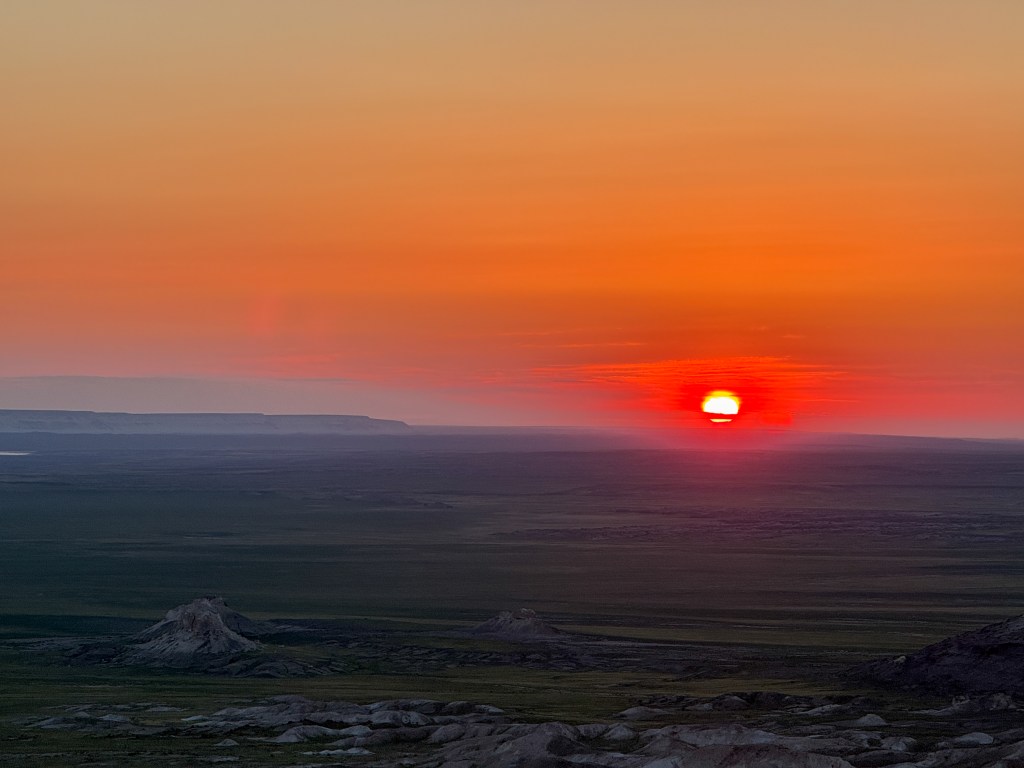
Nearly 350 kilometres, fundamentally a straight line through Karakalpakstan. Steppe as far as the eye can see. No relief, no variation, hardly any landmarks. A landscape that doesn't try to entertain you. One that simply lets you pass through.
Or perhaps not.
Because to this already peculiar emptiness, something else was added: heat. And wind. And not just any wind, but that steady, grinding headwind, which isn't loud, isn't dramatic – but simply is. Always. So constant that at some point it no longer appears as an external condition, but like a part of one's own movement. You pedal, and yet you don't make any real progress.
I had an inkling of what to expect. The day before the border, I cycled the stretch from the border to Beyneu in Kazakhstan with a tailwind. 90 kilometres in just under two and a half hours, on my touring bike. Effortlessly, almost playfully.
I may need to explain that briefly:
The border crossing between Beyneu in Kazakhstan and Karakalpakstan in Uzbekistan is only open for freight traffic. Individual travellers must take the train here. From Beyneu, it is approximately 90 kilometres to the border, Karakalpakstan is about 10 km on the Uzbek side.
As I wanted to have as few gaps as possible on my round-the-world tour, I decided to cycle the 90 km on the Kazakh side anyway.
However, I found it logistically almost impossible to cycle to the border and then somehow get back again without having to cycle the route twice. So, I took a taxi from Beyneu to the border and cycled back. This way, I had the good fortune of a tailwind due to the circumstances.
I'll be able to live with the fact that I'm still missing about 10 km on the Uzbek side.


The next day, back across the border, in the opposite direction: After two and a half hours, nine kilometres were registered on the odometer.
Not ninety. Nine.
I sat in the shade of one of these buildings, the kind that look like someone once decided a break might be a good idea here (and which I didn't take a photo of, so preoccupied was I with myself). No water, no shop, nothing that looked like infrastructure. Just shade. And time to think.
And indeed, I wondered if this was even feasible. 350 km under these conditions – alone? Realistically, probably not. At the same time, waiting wasn't really an option either. The visa starts running once you cross the border. And somewhere in the back of my mind, this train runs parallel to my route every few days, whispering subconsciously: „You could make it easier for yourself.“
So I sat there, and as I was trying to re-sort my own plan, a cyclist appeared on the horizon.

It took me a moment to realise it wasn't an illusion.
There's only this one road here. The train rarely passes. Cycling across the border isn't an option because it's forbidden. And on the train I took, he wasn't there either. But he was. Real, with dust on his face and the same headwind. A 23-year-old Frenchman, on his way to China. He had arrived on an earlier train and was waiting in the border town for the weather to improve.
We met at kilometre nine.
What happened then was perhaps the real core of this section. Not the heat, not the wind, not the distance. We decided to carry on together.

I'm not used to travelling with anyone. Apart from trips with Friederike, I always travel alone, especially on long distances. Travelling alone means: no coordination, no discussion. You drive or you stop. You listen to your body and to no one else.
It works differently with two people.
Fortunately, you quickly notice when the other person falls silent. When someone actually needs a break but says nothing. When it's better to just keep going, even when it's difficult.
We haven't talked much about it – but somehow it's worked astonishingly well. No big meetings, no plan in the traditional sense. More of a shared feeling for how to get through these days.
And perhaps that's the fascinating part: in a landscape where seemingly nothing is happening, precisely that which sustains a journey is happening.
Karakalpakstan itself is hard to grasp. It’s not a region that imposes itself. No postcard idyll, no obvious „highlights.“ It has a palpable weight.
The Aral Sea isn't far. Or rather: what's left of it – and what it has left behind. This steppe isn't just empty. It's the result of something that was once different. More fertile, more vibrant, closer to the water. Little of that can be seen today, but you can feel it. In the dryness, in the dust, in this peculiar mix of vastness and loss.
As you drive through this landscape, you realise it's slowly creeping into your mind too.


Thoughts become simpler. Reduced. It's no longer about grand ideas or plans. It's about stepping forward. The next kilometre. Then the next. And at some point, you realise that there's a kind of peace in that very thing.
After four days, we arrived in Kungrad. The first city. Food. Shade. Sounds. And then came the moment that felt heavier than I had expected: the farewell. Antonin is continuing on. I am staying for a day to go to the former Aral Sea coast after all; by taxi. Something I had removed from my route planning due to the external conditions, but which I so wanted to see.


We're still sitting together, eating something, drinking. Exchanging our last thoughts, nothing more. No grand speeches. And then everyone heads off in their own direction.

As quickly as paths crossed, they part again.
I haven't been this exhausted for a long time as I was that evening.
Not that pleasant „I've exercised“ exhaustion, but truly empty. As if the wind had taken not only energy, but something else too.
And at the same time, there was this feeling that's hard to explain. That these are precisely the days that stick with you. Not because they were beautiful, but because they were intense.
And because they have shown that even a seemingly endless, monotonous steppe has more to tell than one might initially assume.