
Thoughts along the Silk Road – from Mizdahkan to Khiva
It was probably no different during the heyday of the Silk Road than it is today: there were times of movement – and there were times of encounter.
For weeks, caravans travelled through deserts, across steppes and along rivers. These routes connected distant regions, but above all, they were one thing: a passageway.
This only changed at specific points. Travellers paused where paths crossed, where water was available or where people found shelter. Here, space was created for exchange – for trade, stories, religions and ideas.
From these moments of encounter, places of particular significance developed. And from some of these places, cities were born.
Some of them still exist today.
Mizdahkan – City and Necropolis
Mizdahkan is one of those places that defies easy categorisation. Was it a city? A cemetery? A sanctuary?

The answer lies somewhere in between.
The settlement already existed long before the golden age of the Silk Road and later developed into a significant centre in the Khwarazmian Empire – a prosperous oasis civilisation on the Amu Darya (one of Central Asia's most important rivers), which shaped trade, craft, and culture in the region for centuries. In its medieval phase, Mizdahkan belonged to the larger settlements of this landscape and was situated on an important route towards Kunya-Urgench, one of the main hubs of that era.
This place was therefore not just a burial ground at the edge of the world, but part of a living network. Trade, work, and life all took place here – and at the same time, a religiously shaped landscape of memory emerged, which made the place significant beyond the purely economic.


It is precisely this overlay that makes Mizdahkan so special: it is not a place that can be pinned down, but one where different levels become visible simultaneously – city, trading post, and necropolis.
Mizdahkan thus impressively shows how everyday life and spirituality were closely connected along the Silk Road – and how places could change over time without losing their significance.
Chilpiq – a glimpse into another world
Very close by is a place that takes us even further back: Chilpiq Castle.

On an isolated hill rises a round tower, about fifteen metres high and more than sixty metres in diameter. From a distance, it looks like a fortress – massive, closed, almost defiant. But this impression is deceptive.
Chilpiq is a so-called „Tower of Silence“, a Zoroastrian (Zoroastrianism is one of the oldest religions in the world) burial site. Here, the dead were not buried, but laid out on the upper platform, where birds took on the task of decomposing the body. Only later were the remaining bones collected and buried in vessels, so-called ossuaries.
From today's perspective, this seems strange and difficult to comprehend. However, behind this practice lies a clear concept of purity: the elements earth, fire, and water were considered sacred and should not be defiled by the decay of the body.


Chilpiq is thus one of those rare places where not only history opens up, but a completely different worldview – an idea of life and death that shows how fundamentally different Central Asia was shaped long before the arrival of Islam.
Khiva – where history becomes tangible
And then comes Khiva.


After all the scattered clues, the city feels almost unreal, as if someone had preserved the Silk Road itself. While before one saw individual fragments – ruins, hills, relics – here one is suddenly faced with something complete.
Khiva is not a collection of ruins. Khiva is a complete city.
At the centre lies the old city of Itchan Kala, surrounded by a massive clay wall, behind which a dense world of architecture and everyday life unfolds. Within these walls stand dozens of historical buildings, mosques, madrassas, and minarets, interspersed with a multitude of traditional houses that are still in use. I myself had taken accommodation in one such former madrassa, which intensified the impression of actually being part of this place, even if the comfort in a former Koranic school is, as expected, more historical than luxurious.
You don't move from one sight to another here. You move through a connected space where history isn't isolated, but omnipresent.


Khiva was once the last major stop before the desert en route to Persia, the place where caravans made one final halt before venturing into the unknown. And it is precisely this feeling that has endured to this day.
The narrow alleyways, the simple clay walls and the (not always) slender minarets don't feel manufactured. They don't feel reconstructed or restored in the classic sense – rather, as if they've simply remained.
Encounters along the way
And then there are the people.
The school bus
A „school bus“ here is a small white minibus, which incidentally is the dominant vehicle on Uzbek roads. One of these buses, or rather the children in it, had tried to stop me, and had twice driven back to overtake me again. Always with the plea shouted from the window: „stop please“.
Such wishes are becoming more frequent every day, even among adults. They then want to take a selfie.
They tried to stop me several times, first with cautious gestures, then with increasing determination. Eventually, I gave in.
The children were there immediately: curious, open, full of energy – and with surprisingly good English. The usual questions quickly followed, photos were taken, then they moved on.
Later, somewhere on the road, they drove past me again. This time without stopping, just with a wave from the window – and a clear „Thank you“.


It wasn't a big event, not a planned exchange. But a special moment.
The Interview
A small shop by the roadside, just to refill some water.
The usual question comes immediately: Where are you from?
„Germany,“ I say. A brief nod, then a hesitant „Ah... wait.“
A few seconds later, I'm gestured to stay: „Wait. Teacher comes. He speaks German.“
A few minutes pass, then a man actually appears. Direct, friendly, curious.
He turns out to be an English teacher – and also speaks „only“ English. Germany and England are often confused here.
Without much preamble, a short interview begins, obviously routine. Questions about my trip, about Germany, about my impression of the country. Everything is recorded – for his students, as he explains. His final sentence for his teaching video: „Kids, we respect tourists.“.

The impression arises that this is not the first time. Later I see that his Instagram account is full of similar encounters.
Back in Motion
And then the other one comes again.
Not encounter, but movement.


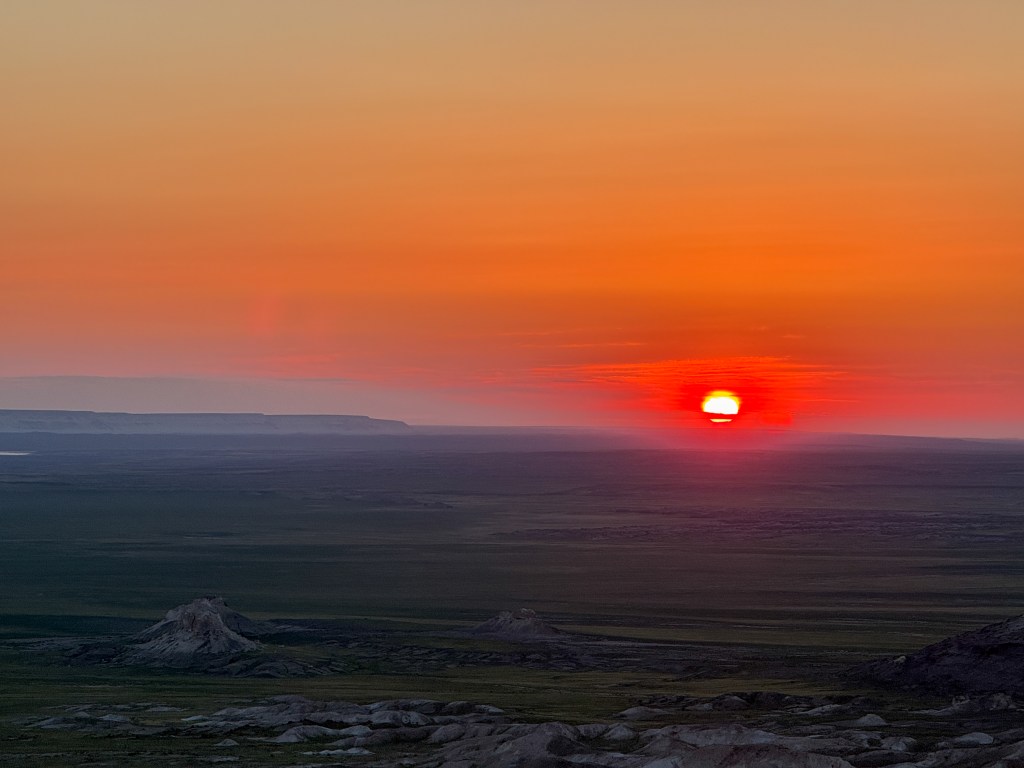
After the places, after the conversations, after the moments of pausing, the moving forward begins again. The landscape becomes wider, emptier, more uniform. Four hundred kilometres of desert lie ahead of me – three days in which there is hardly anything to hold onto.
No cities, no visible history, no places that tell stories. Only distance. Only time. Only the movement itself.
And that, just like all the cities it has connected, is part of the Silk Road.


Arrive
That's behind me now.
And I realise it's not just the body that needs a break. So much has been set in motion in my mind too – impressions, encounters, landscapes that are still resonating.
Over the next few days, in Bukhara, I'll be doing what travellers here probably did centuries ago: arriving, resting, and processing everything that happened on the journey.

Conclusion
The Silk Road is not a continuous experiential space. It thrives on contrasts – on movement and stillness, on emptiness and abundance, on the everyday and spirituality.
It is precisely these changes that define their character. Nothing is constant, everything changes – and it is in this very thing that the true experience of this journey lies.
Mizdahkan, Chilpiq, and Khiva make this very clear. One place preserves memory, the other tells of ritual and worldview, the third stands for life itself, for trade, encounters, and everyday life.
And in between lies what connects everything: The road.