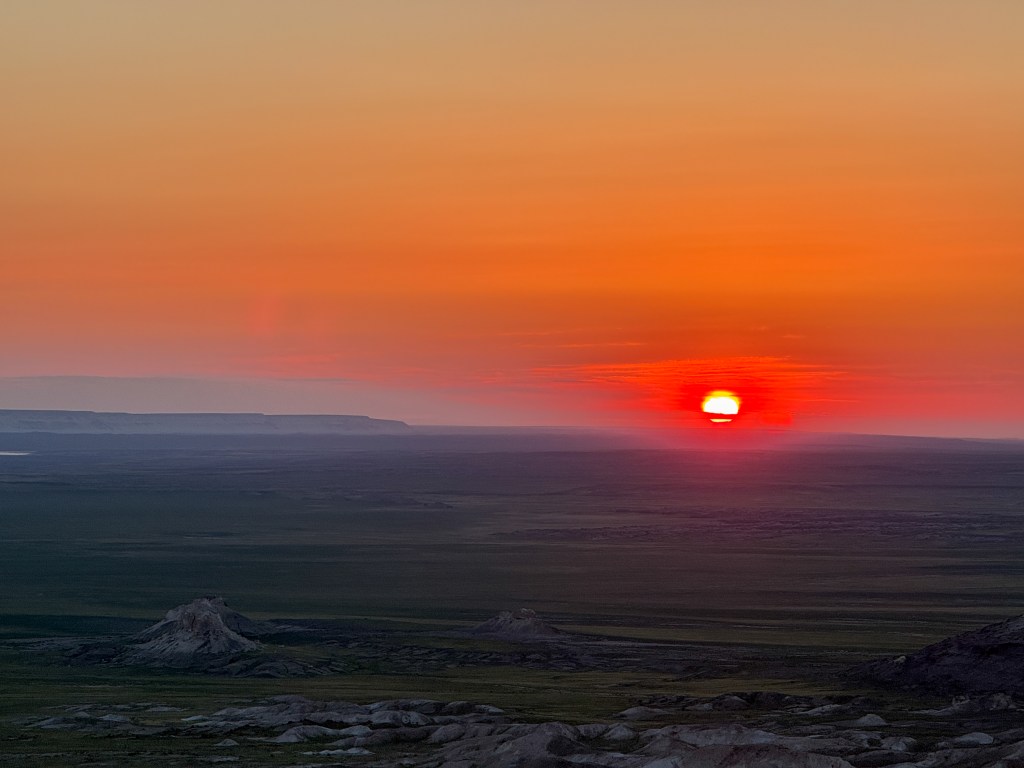

I took the opportunity of a rest day to go on an excursion to the Aral Sea.
Actually, the place Moʻynoq, with about 10,000 inhabitants, a former fishing village on the former shores of the Aral Sea, was on my route. However, given the weather of the past few days, I have, out of pure common sense, initially foregone this detour.
Today I caught up with him – thanks to a tourist couple equipped with a rental car.
The shore is now about 120 kilometres from Moynaq. The town now lies on the southern edge of the Aralkum Desert – the Earth's newest desert.
Even 60 years ago, there was a lake here, roughly the size of Bavaria. Little is left of it today.


The Aral Sea hasn't simply vanished. It has slowly died of thirst. Two large rivers – the Amu Darya and the Syr Darya – once fed it. In the 1960s, their water was increasingly diverted, primarily for cotton cultivation north of the lake. Year after year, less water arrived, while the sun relentlessly evaporated what remained.

And so the lake began to shrink. First imperceptibly. Then visibly. Then dramatically. Eventually, the bottom dried out. And where there used to be water, nothing remained but salt, dust, and an almost unreal emptiness.


On this day, the day I heard of the death of a friend from our Sochumi Group Having experienced it, and where the tears of grief and compassion could only be dried by the high sun, this place became something more than a geographical location.
He became a mirror of my own grief.


The Aral Sea will no longer be „saved“. It is simply too late for that. What is being attempted is more damage limitation – a cautious, almost humble correction of what can no longer be undone.
In the north, on the Kazakh side, a dam was built – the Kokaral Dam. It holds the water together and prevents it from flowing further south. As a result, a small part of the lake has actually grown again: the water level is rising, the salinity is decreasing, and even fish have returned.
And over the much larger area to the south, Uzbekistan is planting a „forest.“ Millions of resilient shrubs, primarily saxaul, are growing on the former seabed. They hold the soil firm and tame the toxic salt storms.


But all of that changes nothing about the fundamental truth: the great Aral Sea will not return. And perhaps that is precisely what is so unsettling about this place – that here one can see very clearly what we are capable of.