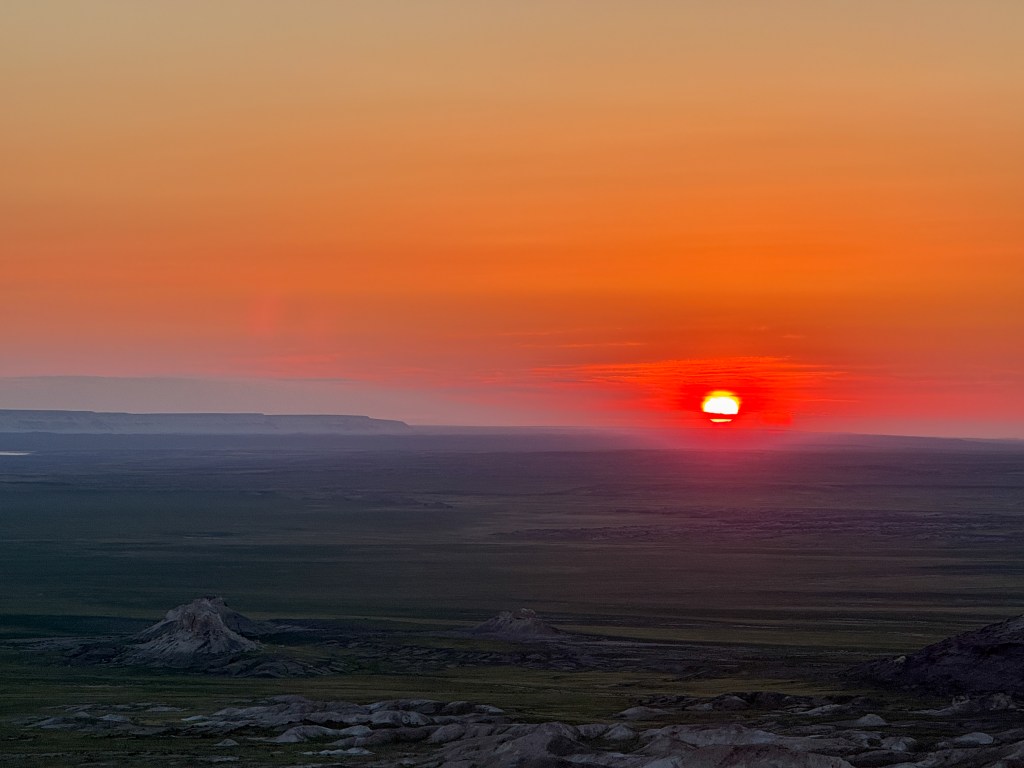

Today, I've left the main Silk Road route for the first time – and suddenly everything seems a little quieter, a little more expansive. This brings to mind a question that has been with me for a while: Why are cities like Khiva, Bukhara, and Samarkand located precisely here?

Central Asia largely consists of the Kyzylkum and Karakum deserts and dry steppes – landscapes that, to put it mildly, offer little incentive to lead a camel for longer than necessary. Long-distance trade was only possible here if one consistently encountered three things: water, food, and shelter. And that is precisely what these cities offered. Samarkand lies in the fertile Zerafshan Valley, while Bukhara and Khiva emerged like islands of life in the midst of the desert – oases that were more than just a geographical stroke of luck.
So the caravans did not simply move across the landscape but from oasis to oasis, like pearls on an invisible string.
A caravan could only cover a limited distance per day, and so fixed stations were established at regular intervals: places to rest, to trade, to repair, to catch your breath.
Buchara, for instance, had dozens of caravanserais – you can imagine them as a mixture of a hotel, a warehouse, and a meeting point for tales from all over the world. These cities were the logistics centres of antiquity.
It was also due to its location that such hubs emerged precisely here: Uzbekistan is situated in the very heart of Eurasian land connections, between China, India, Persia and Europe, between the great river systems of the Amu Darya and Syr Darya. Anyone who wanted to trade could hardly bypass these hubs. And where people regularly pass by, they eventually stay – first as traders, then as artisans, later as scholars, rulers, and entire cultures.
And so, rest stops became cities.
With markets and workshops, with palaces and madrassas (also madrasa: a school in the Islamic cultural region. The word comes from Arabic and literally means „place of learning“), with its own dynamic that went far beyond mere trade.
Over Khiva As I have already told you, and now I have stopped in Bukhara and Samarkand – two cities that lie on the same route, but could hardly be more different.
Bukhara
Buchara seems as if someone has opened a fairytale book and accidentally never closed it again. For over two and a half millennia, it has patiently lain in its oasis, waiting for someone to come from afar.


Previously, these were merchants from China, Persia, or India who stayed in the caravanserais and presumably had conversations very similar to those of today's travellers – just with less Wi-Fi and more spices in the air.
Here the world met in quiet fashion: goods and ideas changed hands, while outside camels snorted and inside it was decided who would move on the next day, richer – or poorer.
Bukhara was not loud, not spectacular, but significant. Thus an area was created which became a centre of knowledge, with mosques, madrasahs and scholars in such numbers that it was reverently called „holy Bukhara“.
Today, the Old Town feels like a living museum, strictly refusing to become any more modern than absolutely necessary. And when you walk through the alleys in the evening, you almost feel as if someone is about to knock on an old wooden door and ask if there is still room in the courtyard for a tired caravan.


Samarkand
And then comes Samarkand – and changes the pace.

Samarkand is not a quiet narrative, but an exclamation mark. A city that is not content to simply exist, but insists on being seen. Here, power was visibly displayed. Here, rulers resided, decisions were made, and empires staged themselves – in stone, in domes, in vast squares like the Registan. Samarkand's heyday was during the time of Timur's empire (late 14th century).
While Bukhara is more introspective, Samarkand looks outwards. Everything is bigger, grander, more monumental, as if someone decided to explore the very definition of „impressive“ to its fullest.


When you walk through Samarkand, it feels like you’re part of a grand historical spectacle. This city doesn’t want to be discovered slowly. It simply stands there – and impresses.


Due to the current political situation, almost all cycle tourists heading east (or vice versa) have to pass through here. Just as they did weeks ago in Tbilisi, they suddenly appear, you meet new cycling companions and old acquaintances whom, in my case, I already met in Turkey. So I was in good company and we had plenty of time in the evenings to exchange experiences and plans, or to forge new ones. Entirely in the spirit of these old places along the Silk Road.
And furthermore, Samarkand is the starting point for the Pamir Mountains adventure for almost everyone. Here, one of the highest main roads on Earth crosses the Ak-Baital Pass (4,655 m), with many sections permanently lying above 3,500 m.
For me, it's now onward towards Tashkent, still a good 400 km, then this section of my round-the-world cycle tour ends.
Addendum
I had a very nice place to stay in Samarkand, by the way; I could even sleep outside under the starry sky.
