
Cycling from Istanbul to Tashkent

I have reached Tashkent. Having covered 5,073 kilometres from Istanbul and 8,617 kilometres since setting off from Norderbrarup, I will now be staying in the Uzbek capital for another week, taking some time to rest and prepare for the journey home: the bike needs to be repacked and the panniers arranged in such a way that the airlines don’t immediately take it as a personal affront. I am very grateful to have made it this far, because on the whole I have been very lucky — with the weather, the wind direction, the people I’ve met, my fellow travellers and, something that is by no means a given on a journey like this, the road traffic too.
I could describe this trip as a route: Istanbul – Tashkent. A line, a few countries, a certain number of kilometres. But that would be a bit like summarising a book by counting its pages. It's true, but it misses the point. Because this journey was never just about places. It was about transitions, about moods, about headwinds, about tea, about the occasional insight that a good day doesn't necessarily have anything to do with a tailwind – although, of course, that would help.
Turkey – The beginning that isn’t really a beginning
Istanbul was not only the starting point, but also the end point of a previous journey. That is precisely why this new beginning felt so right there: not like a break, but more like a continuation. The moment of crossing the Bosphorus was then far less spectacular than I had imagined it to be over the decades. No pathos, no grand pause, no “Right, now the eastern part of my life begins”. More of a quiet: “Right, so now it really begins”. That’s exactly how I described it in “I’m in Asia”, and looking back, it still fits very well.

It soon became clear that Turkey had no intention of letting me ease gently into this journey. Wind, elevation gain, road surfaces with a distinct tendency to be rough — and a landscape that doesn’t constantly strive to please. These are not mountains designed for show. Rather, they are simply there, setting the rules in a very matter-of-fact way: making progress takes effort, and regularly so. The fact that I was able to test every item of clothing right from the start, except for my swimming trunks, therefore had something almost educational about it. “Alternating baths“was a well-chosen title back then.

And then there were these places that, in very different ways, were more than just stop-offs. Cappadocia, for example — a place where I briefly had the impression that someone had forgotten to take down the film set. I was deeply impressed by the way natural wonders and human reality intertwine there; you can read about it in “Cappadocia”.

And Ani, that abandoned city near the Armenian border, was the exact opposite: not a fairytale setting, but a quiet, almost oppressive reminder that even large cities can simply fade from existence at some point: “The Empire the World Forgot”.

What sticks with me most about Turkey, however, are not these places, but the people. That almost irritatingly consistent pattern: first a cup of tea, then a chat, then help, without any fuss. In “On Old Paths to the East”, it was a missing screw on the luggage rack; in “Türkiye, teşekkür ederim” it was the crystallised realisation that this country treated me far more often as a guest than merely as an observer. I often had the feeling that, for a moment, I belonged — and that is more than I can say of a landscape that sometimes pressed me rather uncharmingly against the slope.
Georgia – A place to take a breather
After Turkey, Tbilisi initially felt almost overwhelming. Cars, people, noise — it was all back again. After weeks of wide open spaces and fairly straightforward distractions, I first had to remind myself that cities don’t always take my own rhythm into account. And yet Tbilisi was just right. I was able to do my laundry, plan the next few days, find some peace and — best of all — meet or catch up with other travellers. In “Tbilisi”, I described this contrast between the crumbling old town, sulphur springs, modern buildings and my own need for a break.

What stays with me most from Georgia is this loose-knit community of people on the move. No one calls it into being, no one keeps minutes, no one sets up an association. And yet it comes into being. I sit together with others, sharing bread, wine and stories, and the next day everyone moves on again. That is precisely what makes it so pleasant: it demands nothing and yet sustains. In “Farewells, Borders and Other Coincidences’, it becomes clear just how dear this little travelling community had become to me — precisely because it was so non-committal. Perhaps some things simply work better when they make no claim to permanence.
Azerbaijan – The gap in the picture
Crossing into Azerbaijan was more complicated than a border crossing should really be (“Entering Azerbaijan by land’). Lots of preparation, uncertainty, and in the end a special permit — and yet it remained unclear for a long time whether I would actually be allowed to cross. The fact that leaving Georgia, of all places, required more discussion than entering Azerbaijan was a fine example of how logic has only limited relevance at borders. This is also covered in “Farewells, Borders and Other Coincidences”, and even now, as I write, I realise that the content of this episode has preoccupied me more than I was willing to admit at the time.

The country itself remained elusive to me. Baku tells the story of two eras at once: glass and steel on the one hand, a crumbling past on the other. In between lies plenty of room for interpretation – and, presumably, for misunderstandings too. I saw a great deal there, yet I was left with the feeling that I hadn’t quite grasped the most important part. Perhaps the time was too short. Perhaps I myself was too much in transit mode. Perhaps the country was simply more reserved than I was used to from Turkey. In any case, there remained a void — and that, too, is probably part of travelling, even if, at this point, I would naturally have preferred to come up with a neat conclusion.
Kazakhstan – Setting a new benchmark
For me, Kazakhstan doesn’t begin with a border, but with a feeling. And quite suddenly, at that.
I arrive by ferry – a vessel that falls somewhere between ‘functional’ and ‘a bit off the mark’ (‘Professor Gül – a floating relic’). And by the time I clear immigration, at the latest, it becomes clear: different rules apply now. Or perhaps better put: there are now rules that I don’t yet understand.
What becomes clear very quickly, however, is the sheer scale of this country. Water becomes a factor to be reckoned with, and food a unit of planning. Spontaneity? It’s in rather short supply.

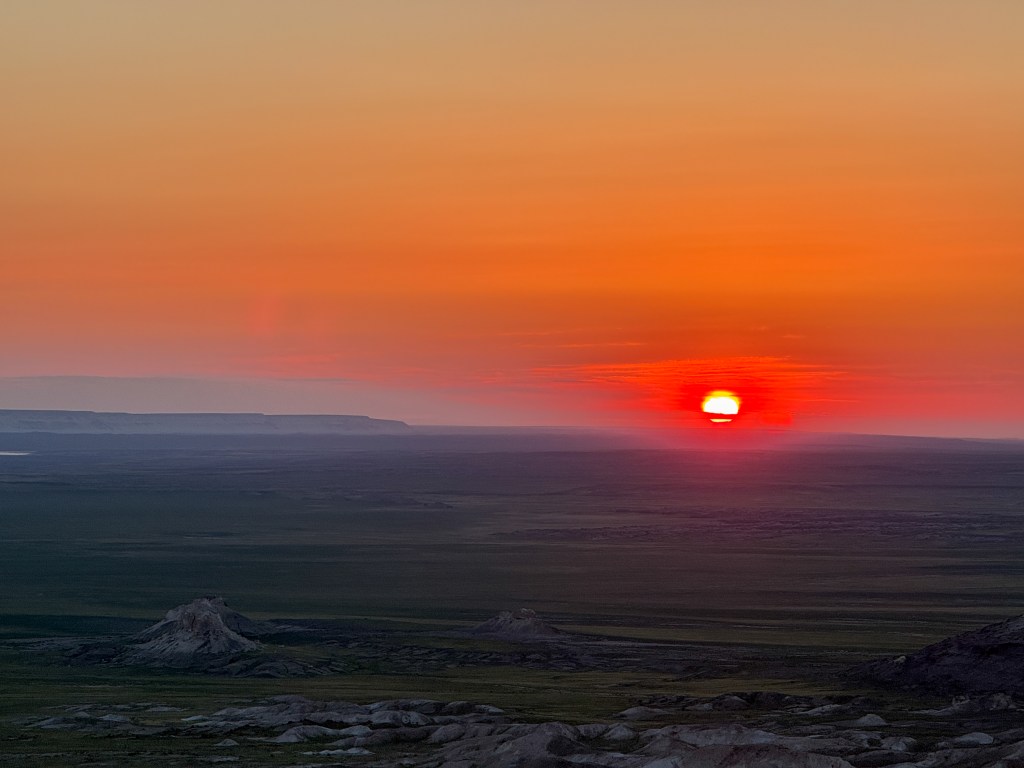
In places, the Mangystau region seems almost excessively vast. It’s as if, when creating this landscape, someone hesitated for a moment – and then decided to simply turn the dial all the way to the right (“Of Pilgrims, Plateaus and Provisions’).
And then the opposite happens again.
I arrive at a place like Shopan-Ata. I get off my bike – and am welcomed as if I’d announced my arrival. Food, a place to sleep, encounters that defy explanation. I still remember clearly the feeling that I don’t really belong here. But no – that’s exactly how it’s meant to be.
Western Uzbekistan – Straight ahead, and I mean it
After visiting Kazakhstan, I actually expected that nothing would surprise me anymore. That’s a classic mistake.
Karakalpakstan is different. Even more stripped-back. The road goes straight ahead. And it stays that way. Not just for a few kilometres – but ‘endlessly’.
Every 70 to 90 kilometres, there’s a chance to buy something. In between, there’s mainly time. Lots of time. And conversations with myself.
And then the wind comes.
Not dramatic, not spectacular. No storm, no drama. Just consistent. So consistent that at some point I start to wonder whether it’s actually coming from outside at all, or has simply become part of my own riding (“Against the Wind”).

Nine kilometres in two and a half hours is a pretty good point at which to at least stop dwelling on this question. And that’s exactly when something happens that I hadn’t planned on: another cyclist appears on the horizon.
I remember thinking at first that it was an optical illusion – which is a perfectly reasonable assumption in this landscape. But it wasn’t.
We’ll carry on together.
What may sound like very little changes everything. Suddenly, there is a sense of rhythm, coordination, quiet communication without words, and drafting. This journey isn’t just about what I can achieve on my own.
A phrase that sticks in your mind
Before long, we find ourselves in a place which – viewed objectively – consists of very little: two shops, a restaurant and a cash machine that has decided not to work today. Our situation: no money, at least not in the right currency.
So the question is: can we also pay in tenge (Kazakhstan’s currency – although we’re in Uzbekistan)?
The reply: “Welcome to Uzbekistan, no money.”
What followed was not just the resolution of a problem, but a full dinner. Salad, meat, tea – everything was there. No fuss, no strings attached.
We’ve often recounted this story during our get-togethers with other cyclists. And every time, we’re still in disbelief at what happened. And that’s probably exactly why it sticks in our minds.
The Aral Sea – A quiet place
The Aral Sea wasn’t a destination in the traditional sense. In fact, I’d actually left it off the itinerary. Practical reasons. The weather. The route.
And then there I am, having been given a lift by a couple of tourists in a hire car.

This place doesn’t make a big fuss about anything. It just stands there – or rather, it no longer stands there. A lake that has vanished. Not suddenly, not spectacularly. But not slowly enough for anyone to have stopped it in time.
On this day, something else happens. A piece of news. A loss. Things that have nothing to do with geography. And suddenly, this place fits the moment far better than I could ever have hoped.
I look at this emptiness – and realise that I’m not just looking at a landscape right now.
The Silk Road – Consolidation
After all that vastness, something almost relieving happens: things start to feel more crowded again.
Orte wie Mizdahkan oder Chilpiq sind nicht einfach Sehenswürdigkeiten. Sie sind Schichten. Geschichte, Religion, Alltag – alles gleichzeitig da, ohne sich groß zu erklären.
And then Khiva.
After weeks of seeing only fragments, this city seems almost unreal. Not because it is particularly spectacular, but because it is whole. Cohesive. Comprehensible, at least to some extent.
I’ve come to realise recently that the Silk Road was more than just a route. It was a system: “movement and encounter” in a certain balance. And its oases were centres of power for entire empires.

And in the end
One evening somewhere in Uzbekistan. I’m invited over. I go into a house. There’s food, tea and conversation.
Everything felt as familiar as it had so many times before on this journey. And yet, somehow, it was different. Because at some point, Kamoliddin began to talk about his daughter. About her illness. The hope they pin on her treatment (“Hospitality as a glimmer of hope”).
I remember that, for a brief moment, I didn’t know how to deal with it.
And then there was really only one option left: to listen. To take the story in. And to pass it on.
As of this evening (3 June 2026), I have received 330 EUR. I am truly overwhelmed. Thank you for your kindness; I will pass the money on to Umida’s father by the end of the week.
Conclusion
As I sit here now and look back, one thing in particular strikes me:
The highlights of this trip are surprisingly unspectacular.
Not Istanbul.
Not Baku.
Not Khiva.
It's the things in between. And perhaps that, precisely, is the essence of this journey.

For those who love statistics:
5,073 kilometres, 53 days on the bike, three punctures, 31,000 metres of climbing and exactly 321 hours in the saddle.